What is Crypto Staking? A Beginner's Guide for 2026
Staking is one of the simplest ways to earn passive income in crypto. You lock up your tokens to help secure a blockchain network — and get paid for it. Think of it like a savings account, except instead of a bank paying you interest, a decentralized network rewards you with more crypto.
Over $50 billion in crypto is currently staked across proof-of-stake networks. In this guide, we'll explain what staking is, how it works, the different types, what you can realistically earn, and the risks you should know about.
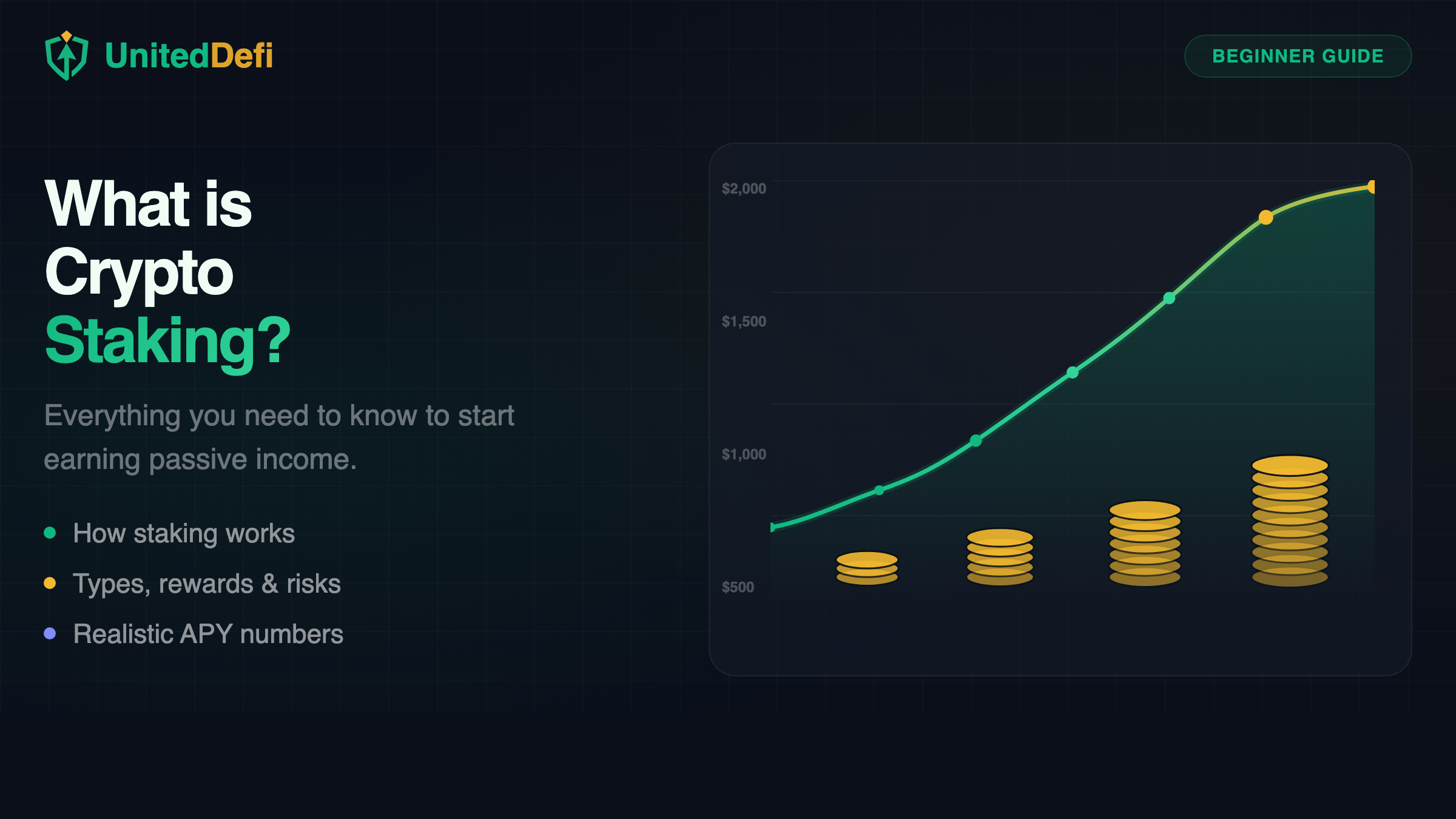
How Does Staking Work?
Proof-of-stake (PoS) blockchains need validators to verify transactions. Instead of using electricity like Bitcoin mining, PoS networks select validators based on how many tokens they've "staked" — locked up as collateral.
You don't need to run a validator node yourself. Most people stake through platforms or protocols that handle the technical side. You deposit your tokens, they get locked for a period, and you earn rewards.
The basic flow is simple:
- You deposit tokens into a staking contract or platform
- The network uses your stake to validate transactions and secure the chain
- You earn rewards — typically paid in the same token you staked
That's it. No trading, no timing the market, no complex strategies. You deposit, you wait, you earn.
Types of Staking
Exchange Staking (Easiest)
Platforms like Binance, Coinbase, and Kraken let you stake with one click. They handle everything — validation, rewards, compounding. The trade-off: they take a 10-25% commission on your rewards, and your tokens are in their custody. If the exchange goes down, so do your funds.
Best for: beginners who want simplicity and don't mind custody risk.
DeFi Protocol Staking (Non-Custodial)
You connect your wallet to a smart contract and deposit directly. No middleman, no KYC, no commission to an exchange. Your tokens stay on-chain, governed by code. The risk shifts to smart contract security — if the code has a bug, funds could be at risk.
Best for: users who want full control and higher yields.
Liquid Staking
A newer approach where you stake your tokens but receive a "receipt token" (like stETH from Lido) that you can still trade or use in DeFi. You earn staking rewards AND keep liquidity. Lido is the biggest player with over $30B in TVL.
Best for: advanced users who want yield without locking up capital.
Delegated Staking
You delegate your tokens to a validator who runs the infrastructure. You share the rewards. Popular on Cosmos, Polkadot, and Cardano. You keep ownership of your tokens but can get "slashed" if your chosen validator misbehaves.
Best for: PoS chain holders who don't want to run their own node.
What Can You Realistically Earn?
| Type | Typical APY | Risk Level | Lock Period |
|---|---|---|---|
| Exchange (ETH, SOL) | 3–8% | Low | Flexible or 30-90 days |
| DeFi lending (Aave) | 3–12% | Medium | None |
| Stablecoin staking | 4–12% | Low-Medium | Varies |
| Liquid staking (Lido) | 3–5% | Medium | None |
| DeFi protocols | 10–30%+ | Medium-High | Varies |
Staking Stablecoins vs Volatile Crypto
Staking ETH at 4% sounds good — until ETH drops 30% in a week. Your $1,000 is now $700, and 4% of $700 doesn't help much.
This is why stablecoin staking (USDT, USDC, DAI) has become so popular. Your principal doesn't move. 1,000 USDT today is still ~1,000 USDT next month. The yield is real profit, not a cushion against volatility.
For a detailed comparison of the two most popular stablecoins for staking, read our USDT vs USDC staking guide.
Risks of Staking
Smart Contract Risk
DeFi protocols are code. Code can have bugs. Even audited contracts can be exploited. Always check if a protocol has been audited by a reputable firm and whether the contract ownership has been renounced.
Platform Risk
When you stake through a centralized platform, your funds are in their custody. If the platform faces issues, your funds may be affected. This is why many users prefer DeFi staking — you interact directly with the smart contract, keeping full control of your assets.
Lock-up Risk
Some protocols lock your tokens for 7-90 days. If the market crashes while your funds are locked, you can't sell. Always understand the unlock terms before depositing.
Slashing Risk
On PoS chains, validators can be "slashed" (penalized) for downtime or misbehavior. If you delegate to a bad validator, you lose a portion of your stake. This doesn't apply to DeFi or stablecoin staking.
Price Volatility
If you stake ETH at $3,000 and earn 5% APY, but ETH drops to $2,000, you're still down significantly despite the rewards. This risk is eliminated with stablecoin staking.
5 Beginner Mistakes to Avoid
- Not understanding the yield source. Before depositing, always check where the APY comes from — transaction fees, lending interest, or token incentives. Each model has different risk profiles
- Not keeping gas for fees. You need BNB, ETH, or SOL to claim rewards or withdraw. Keep at least $1 worth of the native token in your wallet
- Staking everything. Never stake more than you can afford to lock up. Keep an emergency fund in liquid assets
- Ignoring the lock period. Read the terms. A 90-day lock at 8% APY is worse than flexible staking at 5% if you might need the funds
- Skipping contract verification. Before depositing into any DeFi protocol, check: is the contract audited? Is ownership renounced? Is the code verified on-chain?
How to Start Staking Today
- Get a wallet. Install MetaMask or Trust Wallet. Add BNB Smart Chain if you plan to use BSC (see our BSC beginner's guide)
- Choose your asset. USDT for stability (no price risk), ETH/SOL for long-term growth potential, or both
- Pick a platform. Exchange for simplicity, DeFi for control. Compare rates, check audits, read reviews
- Deposit. Connect your wallet, approve the token, and deposit. Start small — you can always add more
- Track and claim. Most protocols show rewards in real time. Claim periodically or let them compound
FAQ
Is staking crypto safe?
Staking itself is a standard blockchain mechanism, but safety depends on where you stake. Exchange staking carries platform risk. DeFi staking carries smart contract risk. Stablecoin staking removes price volatility but not platform risk. Always choose audited protocols with a track record.
How much can I earn staking $1,000?
At 5% APY (typical for exchange staking), $1,000 earns about $50 per year or ~$4.17 per month. At 10% APY (DeFi), that doubles to $100/year. Stablecoin staking on DeFi protocols can yield 4-12% APY, meaning $40-$120 per year on $1,000.
Can I unstake at any time?
Depends on the protocol. Flexible staking lets you withdraw anytime. Locked staking requires you to wait (7-90 days typically). Always check the unstaking terms before depositing.
What's the best crypto to stake in 2026?
For stability: USDT or USDC (4-12% APY, no price risk). For long-term growth: ETH (3-5% APY + price appreciation). For higher yields: SOL (6-8%), DOT (10-14%). For low fees on BSC: USDT via DeFi protocols like UnitedDefi.
Ready to Start Earning?
Staking is the easiest way to make your crypto work for you. No trading skills needed, no complex strategies — just deposit, wait, and earn. Start with an amount you're comfortable with, pick a reputable platform, and let compound interest do the rest.
Stake USDT on UnitedDefi